

What Per Cent Of Interstate Highway Repair Is Paid By The States
How to Fix Our Interstates
Hint: Not with more than asphalt.
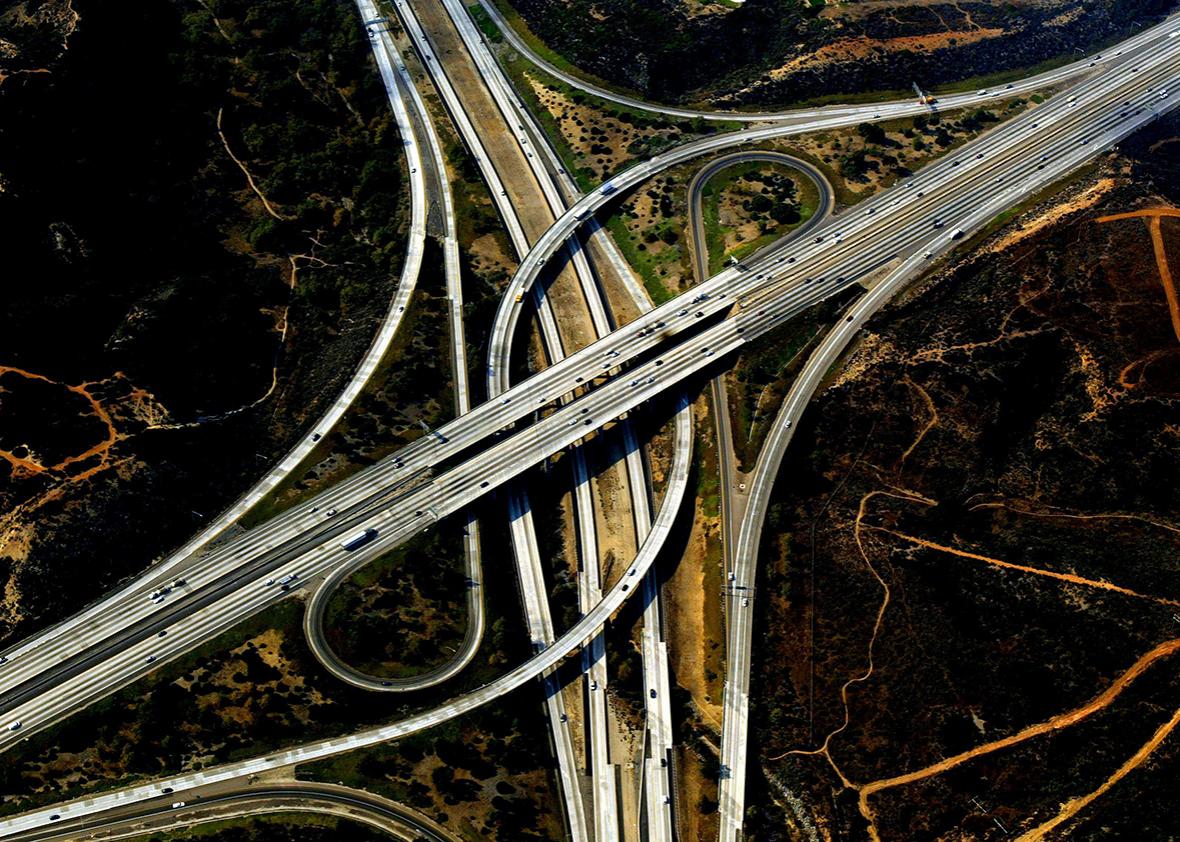
Photo by Donald Miralle/Getty Images
I hate the Interstate Highway Organization. I realize that this is an bad-mannered time to bring this up. Many of you are no dubiousness planning road trips, and I'thou sure you're grateful for the fact that you do not have to traverse dirt roads in your Conestoga railroad vehicle en road to the Thou Coulee. Though I don't know how to drive myself, I can absolutely run across the appeal of barreling down the highway at top speed, singing along to Top twoscore radio between bites of my succulent egg and cheese beige taco. I don't begrudge you your dear of the interstate, nor would I dream of dynamiting it into oblivion. At present that nosotros have these wildly expensive marvels of modern engineering, we shouldn't permit them to crumble, to the point where only Imperator Furiosa and Mad Max would have the guts to drive them. Simply nosotros have to practice something about the interstate highways, because as things stand up, crumbling highways are exactly what we're going to get.
In instance you've missed the latest highway news, the Senate and the Firm accept been contesting it out over which idiotic short-term prepare nosotros ought to settle for in order to go along federal highway funding flowing for the adjacent few months or the next few years. One group of lawmakers, led past Sens. James Inhofe, R-Oklahoma, and Barbara Boxer, D-California, has devised a take hold of bag of acquirement-raisers, from selling off oil in the Strategic Petroleum Reserve to hiking various custom fees to funky maneuvers involving the Federal Reserve that I won't even pretend to understand. This bargain, backed by Senate Majority Leader Mitch McConnell, R-Kentucky, would have financed the highways for the next iii years. Another group, led by Rep. Paul Ryan, R-Wisconsin, chairman of the Business firm Means and Ways Committee, wants to link highway funding to a broader overhaul of corporate taxes, with an eye toward encouraging U.S. multinationals to bring profits back domicile from their foreign subsidiaries. For now, however, Republicans in both chambers appear to have coalesced around a curt-term solution that will fund the highways for the next three months to buy fourth dimension.
What's so awful about these stopgap proposals? For one thing, they don't fully account for the fact that well-nigh of the Interstate Highway Arrangement needs to exist rebuilt, as the highways were built to last virtually 50 years, and the organisation was commencement established in 1956. Even with the best maintenance coin can buy, y'all can only extend the life of these erstwhile roads by and so much. How much volition it cost to rebuild these highways, and to expand them to accommodate increases in traffic? Robert W. Poole Jr., a transportation expert at the Reason Foundation, estimates that it will accept roughly $1 trillion. Others have estimated that reconstruction and modernization could cost equally much every bit $3 trillion. You lot will be shocked to learn that Congress has barely begun to think through what information technology will take to rebuild and upgrade our highways.
Merely our real challenge is not squeezing out only plenty money to keep our existing interstate highways in good working order. Nor is it figuring out how to find a trillion, or trillions, of dollars to pay for an upgrade. Information technology is facing upwards to the fact that the Interstate Highway System has helped drain the life out of our big cities and figuring out a better, smarter, more sustainable way to connect Americans from 1 end of the country to the other.
Though the Interstate Highway System was outset established in 1956, information technology was inspired by a miserable journeying that took place decades before. In 1919, the U.S. Army sent a truck convoy from Washington, D.C., down a long, winding, and occasionally treacherous path to San Francisco. The convoy took only over two months to reach its destination, and the general crappiness of the roads was a retentiveness that ane of the immature officers forth for the ride, Dwight Eisenhower, would never forget. Decades later, afterward Eisenhower had helped shell Nazi Germany in part past taking reward of its autobahns, gleaming superhighways far more avant-garde than almost whatsoever of the roads then in apply in the United States, he decided to make the construction of a vast national highway network his get-go priority as president.
What you might not know, yet, is that according to Helen Leavitt, writer of the felicitously titled Thruway-Superhoax (somehow I suspect Leavitt feels the same way nearly the interstate highways as I practice), Ike didn't realize that the interstate highways would slice through America's biggest cities until it was too late. The consequence of building a centrally planned highway organisation that doesn't just connect cities (an inter-metropolitan system) but that also runs through them (an intra-metropolitan arrangement) has been a bona fide disaster, equally Marlon Boarnet explained in an article published in Transport Policy in January of concluding year. Essentially, proponents of the Interstate Highway Organisation decided that they needed to make its benefits tangible to urban lawmakers, so they included a number of urban highways in their plans. What they failed to reckon with is that a one-size-fits-all approach to highways that might make sense for routes connecting cities across vast distances would by definition accept to ignore the particular local challenges found in each individual metropolis.
Earlier the interstate, local transport plans were local. That is, they were sensitive to the particularities of dissimilar cities and regions, and they were responsive to issues of specially local concern, like limiting traffic congestion and integrating automobiles with other modes of transportation, including public transit. For political reasons, local transportation regime had little selection but to accept that new highways had to minimize disruption in existing neighborhoods. Moreover, planners in this era had to be thoughtful most how this new infrastructure was going to be paid for. The interstate inverse all of that.
In the pre-interstate era, nearly of America'southward superhighways were turnpikes, financed past tolls. Because these roads had to pay for themselves, there was a powerful incentive to avoid building more road than was strictly necessary. Early plans for a national highway system involved tolls equally well. Notwithstanding lawmakers in the Deep South and sparsely populated Western states objected to the idea, fearing that their highways wouldn't generate enough toll revenue to make them financially viable. Thus was built-in the idea of financing the unabridged Interstate Highway System through a federal tax on gasoline, which would redistribute resources from states that generate a lot of gasoline tax revenue to those that generate very little. This new federal tax would fund a Highway Trust Fund, and through it the federal government would meet xc percentage of the toll of new highway construction, including local highway construction. Since the Interstate Highway System was almost entirely funded by the federal government, local policymakers found it hard to resist going along with plans that tore neighborhoods apart. Who in their right mind would refuse "free" money? Who would turn information technology down if the neighborhoods that were being destroyed were full of people who didn't have a ton of political power, equally was oft the case?
While this arroyo seemed to work pretty well in the first few decades of the interstate, it has proven destructive in the long term. Over time, as the cost of maintaining the federal highways has crept upward, lawmakers have been reluctant to enhance the gas revenue enhancement to a level high plenty to proceed up with ascension costs. Then every few years Congress has to scramble to find some clever way to forestall federal highways from falling into utter decrepitude. Information technology turns out that redistributing gas taxation acquirement from states with lots of drivers to those with very few also means redistributing gas revenue enhancement revenue from states that need more transportation infrastructure than they have to states that have more transportation infrastructure than they need.
In the late 1950s and 1960s, most observers didn't see new federally funded urban highways as a trouble. Rather, they saw them as an heady new tool to revitalize downtowns and to raze so-called slums, some of which were in fact living, breathing, tightknit neighborhoods. This optimistic take proved wildly off-base. Nathaniel Baum-Snow, an economist at Brown Academy, analyzed the effect of highway construction on U.S. cities from 1950 to 1990. By comparing cities that received many new highways over this period with those that did not, he estimates that 1 new highway passing through a central city reduced its population by roughly xviii percent. Where did these people wind upwards? In the suburbs, of course. Furthermore, Baum-Snow estimates that while the amass population of America's major cities declined by 17 per centum in the wake of the construction of the Interstate Highway System, this population would accept grown by 8 per centum had the interstate highways never been built.
Being a sober and responsible scholar, Baum-Snowfall never rail against suburban sprawl. In other work, he'southward offered reason to believe that sprawl has yielded some pocket-size economic benefits. I take a different view. In a counterfactual interstate-free world, Americans would likely be living in denser, more compact communities, where they'd spend more time walking and less fourth dimension driving. We'd nonetheless have suburbs, to be sure, but I'm guessing they'd feature more apartment buildings and fewer cul-de-sacs. Local infrastructure would have needed to exist financed locally, and and so cities that had mastered the art of building and maintaining infrastructure efficiently would enjoy a huge advantage over those that had not. Instead, our central cities have shrunk, our suburbs have sprawled, and we've grown dependent on a gargantuan federal highway arrangement that has grown frighteningly expensive.
In a perfect world, we could hop in a time machine and convince Ike that the Interstate Highway Organisation was in fact a terrible idea. Allow state governments keep building turnpikes. Let states and cities build their own local infrastructure, financed past local drivers and guided past local wisdom. If poor states wanted to build gleaming new superhighways, well, encourage them to issue bonds to pay for them, to exist paid back through their own gas taxes.
Assuming fourth dimension travel is off the table, let'south learn from our mistakes. First, let'due south get the federal government completely out of the business of maintaining the interstate highways crisscrossing our big metropolitan areas. Hand these roads over to state governments as soon as possible, and gratuitous state governments to finance these roads in any style they come across fit, from higher state gas taxes to variable tolls they could employ to reduce traffic congestion. Second, for interstate highways that connect cities across deserts and cornfields, let's replace the federal gasoline tax with per-mile tolls. 1 of the many problems with the gas tax is that as gas mileage improves, and as a minor merely growing number of drivers turn to electric vehicles, gas tax revenue is not keeping up with the needs of the highway system. Per-mile tolls tin can solve that trouble by charging drivers co-ordinate to how much they actually use the highway organisation, regardless of the kind of vehicle they're driving. And as Robert W. Poole Jr. explains, they can be pegged to the cost of each road and bridge, which volition help ensure that roads and bridges are adequately financed.
After adopting this approach, we will run across states investing in the infrastructure projects that best run into their needs, with some states, like California and New York, choosing to invest more than heavily in urban mass transit while others, like Texas and Utah, build bigger and better highways. What remains of the federal highway system, meanwhile, will evolve over fourth dimension, as the routes that attract the most traffic will grow in line with their per-mile toll revenue while those that attract the least will stay the same size, or maybe even compress. Nosotros'll accept an infrastructure worthy of a bigger, denser, more than decentralized America—the kind of infrastructure that Ike, in his infinite wisdom, would be proud of.
*Update, July 29, 2015, at i:17 p.m.: Due to a production error, an outdated version of this article was originally posted. The text has been updated to reflect changes that were made by the author before publication simply later on an initial edit.

Source: https://slate.com/news-and-politics/2015/07/interstate-highway-system-how-to-fix-a-broken-expensive-harmful-system.html
Posted by: larsonexampations.blogspot.com
0 Response to "What Per Cent Of Interstate Highway Repair Is Paid By The States"
Post a Comment