

How To Repair Split On Hardwood Floor Board
Expert advice on how to repair hardwood flooring water damage, repairing a hardwood flooring end, fixing wood flooring scratches, hardwood floor gouge repair, and more than
Even the best wood floors are subject to impairment. Hardwood flooring, by its name, sounds similar it should be really hard. But, compared to other materials like tile, rock, and laminate, it is relatively soft and prone to impairment such as scratches, gouges, and discoloration.
Unfortunately, surface scratches and gouges are the inevitable result of daily wear and tear.
Below we show you how to repair minor scratches and gouges. If your floor has many scratches or gouges, information technology's probably time for floor refinishing.
The price of refinishing a hardwood floor volition depend upon the condition of your floor, the blazon of wood flooring, and the number of square feet to be refinished.
Refinishing a wood floor is a big job that involves moving furniture, bringing in a drum sander or other floor sanders, protecting the balance of your house from dust, dealing with odors from polyurethane or other finishing products, and more.
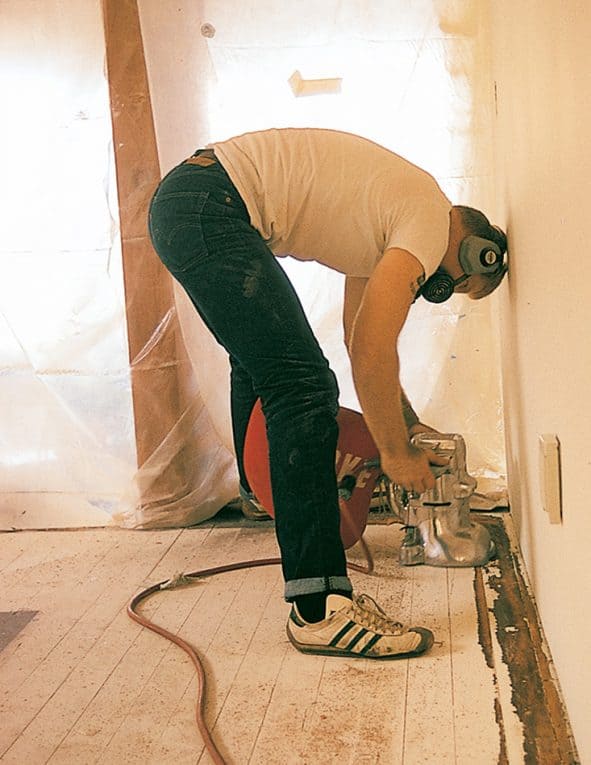
Because it's easy to ruin an expensive wood floor, refinishing a hardwood floor is often best left in the easily of flooring contractors.
Yous tin can't hands prevent issues caused by expansion and contraction. Woods, every bit a naturally fibrous and porous material, expands and contracts with changes in temperature and humidity. Equally it does and so, boards can separate or warp and nails tin can loosen.
With expansion and contraction—and move in full general—hardwood floors can develop squeaks. For methods of fixing squeaks, see How to Prepare Flooring Squeaks.
The natural settling of a business firm can also crusade separations betwixt the joists and the subfloor. If your floor is sagging or uneven, there could exist a serious structural problem causing it. If this is this example with your abode, consult a contractor. If the problem is minor, there are some things you can practise to set up a billowy or sagging floor.
To maintain wood floors, vacuum or dry-mop them about once a calendar week.
Repair Hardwood Floor H2o Damage
In full general, water is an enemy to wood floors. It can damage the cease, leave rings or discoloration or—at its worst—cause floor boards to cup, warp, buckle, or grow mold.
Water damage to hardwood floors can be from minor to major. It can be caused past a potted plant that leaks onto the flooring, from a flare-up appliance supply hose, or from major flooding.
Methods for dealing with hardwood floor water harm depend upon the severity of the harm.
Severe h2o impairment. If several hardwood flooring boards have warped because of excessive h2o impairment, they'll probably need to be removed and replaced. In many cases, you can replace only the damaged areas. In club to do this, you lot'll need to be able to identify and purchase identical replacements. Of course, this isn't always possible.
This video shows how a professional floor contractor removed and replaced severely h2o damaged hardwood flooring:
Removing a water stain. If someone has left a h2o-mark ring from a hot coffee cup or cold drinking glass on the flooring, you might be able to extract the stain.
Fold a white cloth or rag in half and lay information technology over the stain. And so set an fe to medium heat and use it to fe back and forth over the stain area. Exercise this gradually, checking frequently to run across whether the stain is disappearing and to make sure you don't crusade further damage.
Larger stains on forest floors are typically h2o marks, acquired by spills or over-watering business firm plants. The area must be sanded, sometimes bleached, and so refinished to match the rest of the flooring, which is the trickiest part.
It's a good idea to hire a flooring contractor for dealing with a big stain, particularly if the stain is in a highly visible expanse.
If yous do determine to take on this project yourself, this is how the process goes:
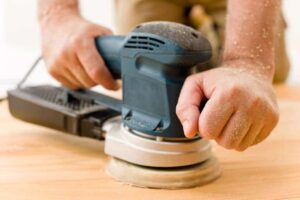
1 Sand the area with a vibrating sander, outset with 100-dust sandpaper and then with 150-grit.
two Vacuum the area with a shop vacuum.
3 Wipe the area with mineral spirits for an oil-based stain and water for a latex stain.
iv For a dark stain, apply bleach or oxalic acid co-ordinate to label directions to lighten the stain, and then lightly sand in line with forest grain, using 150-grit sandpaper.
five Mix up a stain to match the existing floor color. This process usually requires testing possibilities on a piece of wood that's the same species equally your flooring.
If you tin can't find replacement pieces, cut them from a closet or another inconspicuous part of your existing floor and and then supersede that cutout with newer flooring.

+

Find a Wood Flooring Repair Pro Nigh You lot
Repair Hardwood Floor Scratches
Minor scratches in wood floors often can be buffed away using steel wool or hand-sanding with progressively finer sandpaper grits.
When sanding pocket-size scratches, restrict your sanding to the scratched area, feathering simply slightly into the surrounding surface. Always sand or buff only in line with the wood grain.
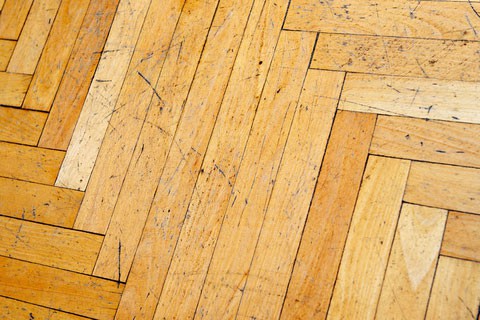
Polyurethane finishes are hard to sand. Try using a scouring pad dipped in mineral spirits or use a sanding screen.

Don't ever wax a wood floor that has been coated with a polyurethane finish—this will make it impossible to re-glaze in the future without having to sand the flooring first.
If paste wax will adhere to the end, you can use it to hide scratches, and the wax is bachelor in clear, love tone, or brown to match nearly any wood floor. Woods-repair wax sticks may help to fill deeper scratches and dents.
Ready Hardwood Gouges and Dents
You can sometimes raise small dents by placing a few drops of water on them and allowing the wood to swell back to its original shape. Applying mild oestrus with an atomic number 26 on a thick cloth or a heat gun helps this process along.
For deep gouges or dents, y'all can utilize a forest floor filler and wood stain to repair the damaged area. Before applying the filler, tape off the damaged area and so y'all don't accidentally utilize filler where it doesn't belong.
Mix equal parts of the epoxy-based filler and apply to the gouge with a putty knife. Allow to dry. Then sand and finish.
The following video by Russ Richards shows exactly how to do this. Note how he mixed two different finishes to achieve the right color. You can purchase the wood floor filler he uses, Elmer's Damaged Forest, on Amazon.
Replace Damaged Wood Flooring
Badly damaged or rotted sections of flooring must be removed and replaced with new pieces. This involves cutting out or prying up a department of the finish flooring, gluing or nailing replacements to the subflooring, filling cracks to lucifer, sanding the surface, and refinishing.
If you're non experienced with this type of work, you'll find the most difficult part is getting the new pieces to match the old. This job is unremarkably best left to a wood-flooring professional. Staining and finishing to get the repair to match your existing floor may require more than piece of work and time than the repair itself. In fact, you lot may ultimately have to sand and refinish the entire flooring to hide the repair.
if possible, buy replacement floor that matches the size and color of your existing flooring. If y'all can't observe an exact match and y'all only demand one or two minor replacement pieces, consider removing those pieces from an inconspicuous place on your existing floor (such as a closet). And so y'all tin repair that area with new fabric that doesn't friction match equally well.
In some cases, it's easiest to remove and supplant a full-length board. Then once more, if a damaged board is long, information technology's generally best to replace only a portion of it. If more than one board must be replaced, stagger the end joints.
Cut Out the Damaged Board
The first step is to cut out the damaged portion. To foreclose splintering when you cut the lath, mark the cut line with a square and a utility pocketknife.
The best tool for cut out a department of woods flooring is an oscillating multi-tool, as shown in this photograph. For more about this tool, come across the HomeTips Aquiver Multi-Tool Buying Guide.
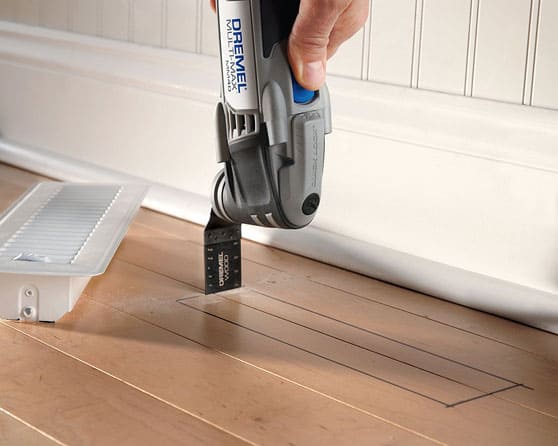
If yous don't take this blazon of tool, make the cut with a hammer and a sharp chisel. Hold the chisel with the bevel facing the expanse to exist removed.
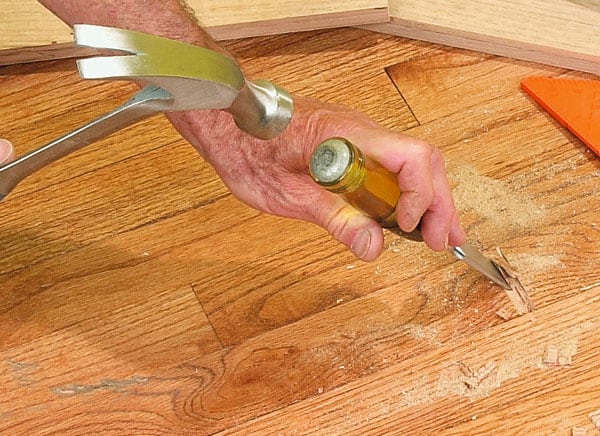
To remove the woods between two cuts, bore two rows of iii⁄viii-inch holes, spaced 4 to vi inches apart, and across the center of the damaged plank. Don't damage side by side flooring. So, using a hammer and chisel, split out the wood between the holes and pry out the pieces.
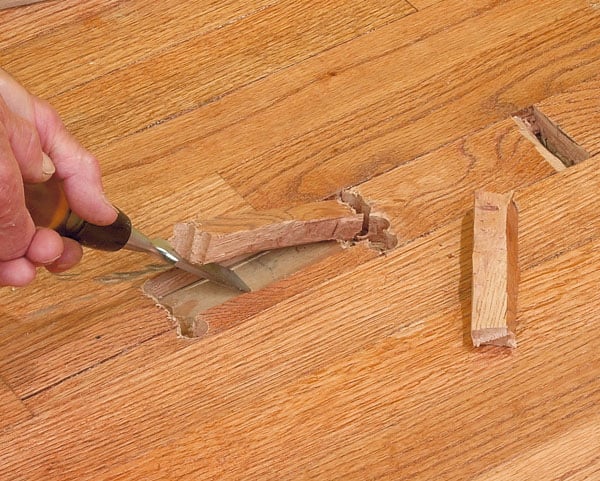
Installing the Replacement
Cut each replacement board to verbal length. If necessary, cut off the lower shoulder of the groove and then yous can fit the lath into place. You tin chisel this shoulder off or, if you lot have a tabular array saw, rip it with the saw.
When y'all tap the replacement into place with a hammer, protect it with a scrap of wood or floor.
Drill pilot holes, and so finishing nails to fasten the replacement lath and the ends of the existing flooring to the subfloor.
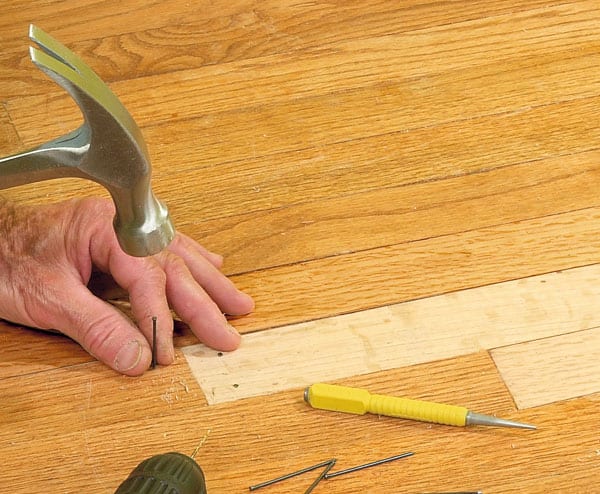
Gear up the fastener heads below the surface, using a nailset. And then fill with matching woods putty.
Depending upon the extent of refinishing that you'll be doing, y'all may desire to utilise a ability sander or a mitt sander to bring the patch fifty-fifty with the level of the surrounding floor, just be careful not to sand as well much!

Laminate Floor Replacement
If your floor is a laminate wood flooring, as opposed to solid hardwood flooring, you may be able to supplant damaged pieces. This video shows how one homeowner replaced a couple of warped laminate woods floor boards in his kitchen:
Discover a Pre-Screened Local Woods Flooring Repair Pro
Tools for Sanding Floors
You tin can rent these iii critical tools for sanding a forest floor: drum sander, random-orbital sander, and edge sander.

Sanding a woods floor is not something to take lightly. Though an experienced do-it-yourselfer can oftentimes handle this task, think twice if you're a newbie at home repairs.
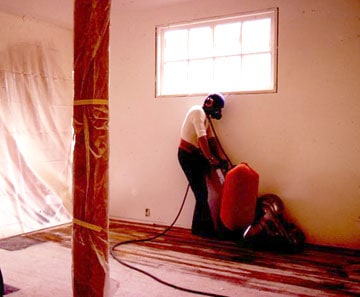
Sanding a wood floor is a difficult job that has potential for disaster. A poor chore can result in permanently wavy bumps or visible scratches on what otherwise could be a beautiful wood floor. Our general advice is to hire a professional person floor refinisher unless you lot're achieved at this piece of work.
Unless yous're doing a couple of small repairs or working in a tiny area, you're going to need professional tools for sanding a wood floor. 3 main types of flooring sanders are bachelor, as discussed beneath. To practice a complete task, you lot'll need all three. To purchase these, you would pay thousands of dollars; fortunately, you can rent them from a tool rental supply or major domicile improvement center.
Yous will also demand a heavy-duty vacuum for keeping the dust down—about of these sanders are designed to be connected to dust-control vacuums. Talk with the rental desk nigh a vacuum that tin be connected to the sanders.
Besides buy enough sandpaper for your job. The amount and grits you volition demand depend upon the size of the floors and the nature of the finishes yous'll be removing. (Ask the dealer for recommendations.) When using whatever floor sander, you volition be working from rough sandpaper that removes a lot of material (20-dust) to progressively less abrasive sandpaper: threescore-, 80-, and 120-dust to eliminate scratches and produce a fine stop.
Other supplies yous'll need include masking tape and plastic sheeting for protecting areas from sanding grit. You lot can buy or hire the necessary safety equipment: a respirator, hearing protection, goggles, and work gloves.
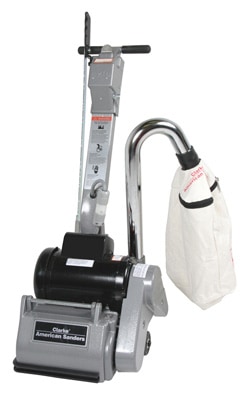
Drum Floor Sanders
A drum sander is used for the offset stage of a floor-sanding chore. You stand up to operate this very heavy upright machine. It rolls an 8- or 12-inch-wide sandpaper chugalug across a series of drum rollers so that the sandpaper moves in a directly line. On unsanded new forest flooring, a drum sander may be operated on a diagonal to the wood grain at first to flatten the irregular surface. But for refinishing and finer sanding, it should be operated simply in line with the management of the wood grain to avoid leaving scratches, skips, or chatter marks. To rent a drum sander, expect to pay from $50 to $75 a day.
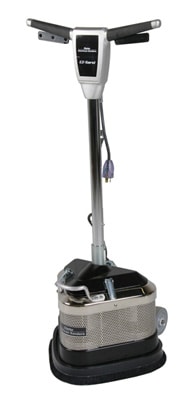
Random-Orbital Sanders
A random-orbital sander is used to remove scratch patterns created by drum or rotary sanders, in preparation for the final finish. In improver, it is used in small areas and tight spaces where a drum sander would be hard to maneuver and on herringbone, parquet, and ornamental floors. This sander is as well used with fine-dust sandpaper for "screen and recoat" jobs, where minimal sanding is required.
At the orbital sander's base, sandpaper is fitted to a flat pad that moves in infinitesimal dorsum-and-forth and oval vibrating motions. Because of these tiny movements, this blazon of sander is much less prone to scratch the wood than sanders that movement the sandpaper in i direction.
You tin get types with a rounded base of operations or a rectangular base. Floor models can exist rented for about $thirty to $50 per day. For very small piece of work, yous can buy palm-sized models for from $l to $100.
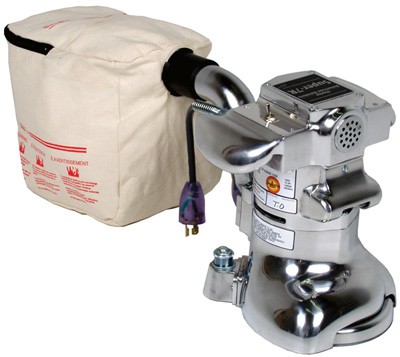
Border Sanders
An edge sander, or "edger," is a smaller sander that y'all typically operate from a kneeling position. The edger is designed to work right up to base moldings and walls and get into tight spots where a drum sander can't become. Information technology includes a dust bag and has an orbital motion, like the random-orbital sander above correct. You can buy an orbital sander for effectually $200 or rent one for virtually $30 per day.
Featured Resource: Find a Pre-Screened Local Wood Floor Repair Pro

Source: https://www.hometips.com/repair-fix/hard-wood-floors.html
Posted by: larsonexampations.blogspot.com
0 Response to "How To Repair Split On Hardwood Floor Board"
Post a Comment